Newly released records revisit the bureau’s long-running investigation into Elton Simpson before the deadly ISIS-inspired shooting.
On May 3, 2015, Elton Simpson and Nadir Soofi pulled up to the Curtis Culwell Center in Garland, Texas, body-armored and armed with assault rifles, and opened fire on security personnel outside a “Muhammad Art Exhibit and Contest.” A Garland police traffic officer shot and killed both men within seconds, ending an attack that wounded a security guard and made international headlines. A newly surfaced FBI Vault case file is renewing attention to just how long the bureau had Simpson on its radar before that morning, and how close federal agents came to warning local police in time.
According to the FBI’s own account, the agency had been investigating Simpson on and off since 2006, when he came to its attention over alleged ties to Hassan Abu Jihaad, a former U.S. Navy sailor later convicted of disclosing classified ship movements to people connected to terrorism. Surveillance recordings from that period, later made public, captured Simpson telling associates he wanted to “go to the battlefield” and join a terror group overseas.
 Free — the opening chapterUnits Are SurroundedFive shootings in five months between members of the Soboba Indian Reservation and law enforcement in the Hemet area of Riverside County. My story about being in the middle of it. The full book is coming.Read how it starts
In 2009, while still under FBI watch, Simpson booked a plane ticket to South Africa, telling a friend in a recorded conversation that a religious school there was a “front” and that he intended to make his way to Somalia. He denied that intention when FBI agents later questioned him directly. He was arrested in January 2010 and convicted in March 2011 of lying to federal agents about his travel plans, a case that ended with three years of probation. The court found prosecutors had not proven his travel was sufficiently tied to international terrorism. His public defender at the time, Kristina Sitton, told reporters after the Garland attack that she saw no signs of radicalization in him and described him as “kind-hearted” and “respectful.”
The bureau reopened its file on Simpson in March 2015, two months before the attack, after he began posting statements online signaling renewed interest in jihad, this time aligned with ISIS rather than the Somalia-based group he had been investigated over years earlier. Investigators have said he was in contact over Twitter with Mohamed Abdullahi Hassan, an American-born ISIS propagandist using the alias Mujahid Miski, who praised the January 2015 Charlie Hebdo shooting in Paris and urged followers to act in the United States. Authorities also believe now-deceased ISIS hacker and recruiter Junaid Hussain had been in direct contact with Simpson and encouraged the Garland plot.
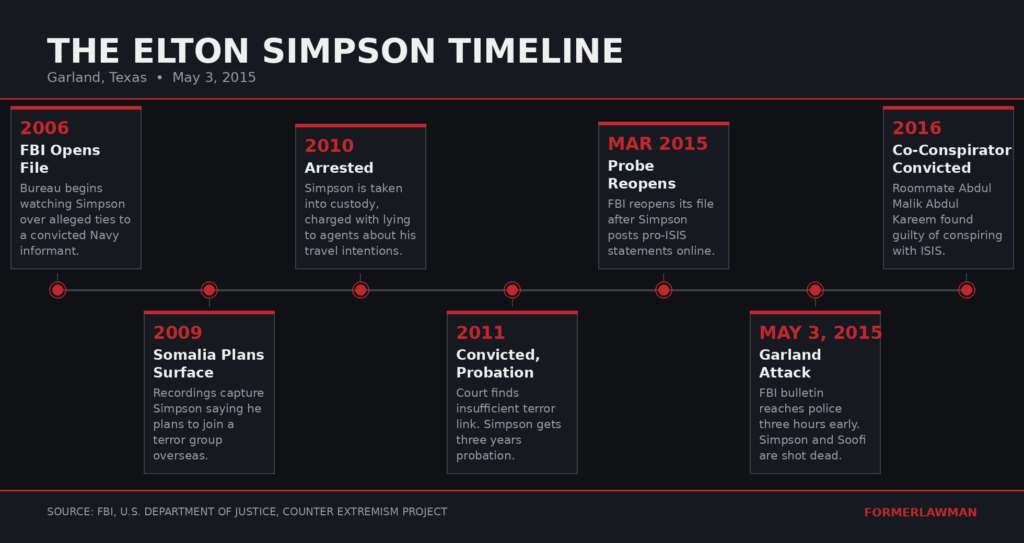
Then-FBI Director James Comey later confirmed that the bureau sent a bulletin to Garland police roughly three hours before the attack, including a photograph of Simpson and a note that he had shown interest in the contest. At that point, Comey said, agents had no information suggesting Simpson intended to attack the event or that he was already en route. He said he did not believe the officer who ultimately shot Simpson and Soofi was aware the bulletin had gone out. The FBI and Department of Homeland Security had also issued a broader advisory two weeks earlier, warning law enforcement nationwide that the contest could draw the attention of Islamic extremists after ISIS supporters circulated links to it on social media.
Minutes before the shooting, Simpson tweeted, “May Allah accept us as mujahideen,” using the hashtag #Texasattack. ISIS claimed the attack within hours and referred to Simpson and Soofi as its “soldiers.”
A federal investigation that followed led to the conviction of Abdul Malik Abdul Kareem, a roommate of Simpson and Soofi, who prosecutors said helped plan the attack and provided one of the rifles used. A jury found Kareem guilty in March 2016 of conspiring to provide material support to ISIS and other terrorism-related offenses. Investigators said the three men had discussed a range of potential targets dating back to June 2014, including military installations, individual service members, shopping centers and the Super Bowl held that year in Glendale, Arizona, before settling on the Garland event.
The newly released Vault file adds to a public record that has long raised questions about how a man surveilled by the FBI for nearly a decade was able to carry out an attack the bureau itself had flagged as a possible target just hours earlier.

Units Are Surrounded
The new book from Ray Dietrich. Five shootings in five months in Riverside County. The full book is coming - read how it starts, free.
