I spent twenty years in the sheriff’s department. Patrol, investigations, gangs, jails, patrol sergeant. I have been in a gunfight. I have sat in a hospital and given blood for a deputy fighting to stay alive after he was shot. I have made notifications that destroyed families in the span of a sentence. I have stood at gravesites in dress uniform while the department rendered final honors to men who didn’t make it home.
I follow the evidence where it goes — even when that’s uncomfortable. I’ve called bad shootings bad on this channel and I’ll keep doing it.
So when I tell you a piece published this week on Police1 is dangerous, soft, administrative nonsense dressed up in academic credentials — understand that’s not a political statement. That’s a professional one.

Who Is Making This Argument
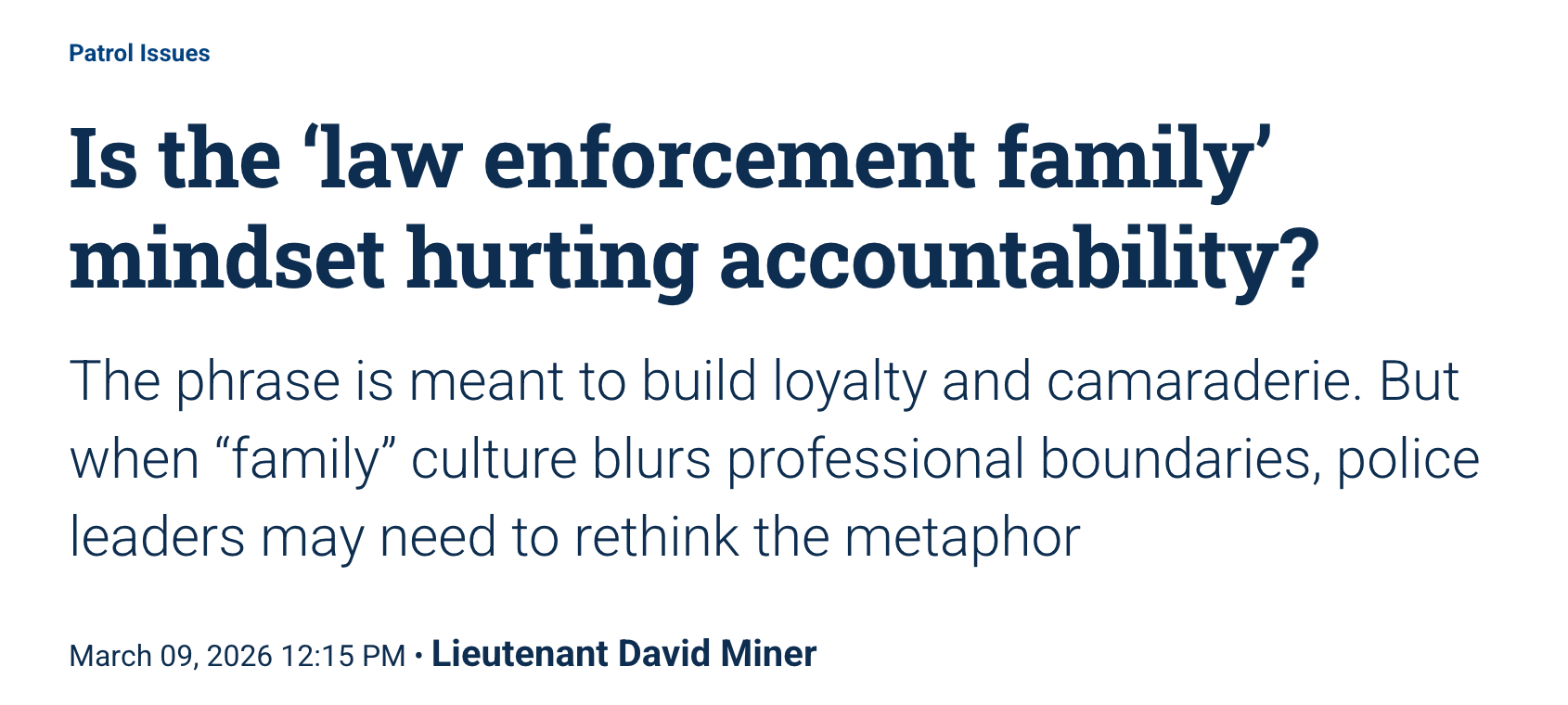
A lieutenant named David Miner published a piece on Police1 arguing that the law enforcement family mindset is hurting accountability. He holds a Doctor of Criminal Justice — a terminal degree, meaning the highest credential available in his field. He is an FBI National Academy graduate and a National Institute of Justice LEADS scholar.
He also works at the Groton Town Police Department in Groton, Connecticut. Small agency. His own government bio notes he is the first sworn officer in his department’s history to earn a terminal degree — which tells you something about the size of the place. His resume includes serving as the CALEA accreditation manager, Citizens Police Academy instructor, and Awards Board Chair. His doctoral dissertation examined shift work and aggression. His stated research interests are officer wellness, juvenile justice, and crisis intervention.
Good for him. That is a serious amount of academic work. But when someone publishes a sweeping argument about how law enforcement culture needs to be fundamentally restructured — built from a resume that runs heavier on classrooms, accreditation meetings, and government research programs than on working violent crime — that context matters. That is not the biography of someone who has spent years in the rooms where this stuff gets real. With respect, Lieutenant, you may want to sit this one out.
What He Actually Argues
His argument is this: the law enforcement family mindset is hurting accountability. Too much loyalty. Too much brotherhood. Too much emotional attachment to the badge. His solution is to stop calling yourselves a family and start calling yourselves a team. Bring in performance metrics. Measure outcomes. Coach instead of rescue.
You know what that is? That is a LinkedIn post. That is a TED talk for people who have never had to fight somebody in a parking lot at midnight. That is HR dressed up in a duty belt.
Where He Loses the Thread
He argues that family loyalty is unconditional — and that unconditional loyalty is dangerous in law enforcement because it shields bad actors. His fix is to replace it with a team model. Conditional trust. Earned through performance. Measured through outcomes.
Fine. Sounds clean on paper. Now go tell that to a deputy working a rural county at three in the morning, thirty minutes from backup, about to put hands on a two-hundred-and-fifty-pound methhead who just told him he’s not going to jail.
What gets that deputy through that moment? What produces the mindset to act when everything in your nervous system is screaming at you to wait? It is not a quarterly performance review. It is not a coaching session with a supervisor about measurable outcomes. It is the absolute bone-deep knowledge that the people in that department would walk through fire for you — and you for them.
That is not a team. Teams get traded. Teams get cut. Teams get a new coaching staff when ownership decides to go in a different direction.
You do not bleed for a team. You bleed for your family.
The Accountability Argument Turned Around
The lieutenant quotes a veteran officer who said the department only feels like family until you actually need help — then it’s business with extra guilt. That’s real in some places. But pay close attention to what that cop is actually describing. He is describing a place where leadership made the promise and then broke it when it got hard. The answer to a broken promise is not to stop making promises. The answer is leadership with enough spine to actually keep them.

When he says family culture enables cover-ups and protects dirty cops — he is describing what happens when weak men are in charge. That is a personnel failure. That is an admin failure. It has nothing to do with whether the officers in the locker room would take a bullet for each other.
What Actually Happens When You Run This Experiment
You get what we have been watching for years. Cops who hesitate at the critical moment. Who disengage. Who do exactly what is required and nothing more. Who stand at the edge of a situation and run the personal liability math in their heads before they move. You get a generation of cops who have been told — through policy, through culture, through watching their colleagues get hung out to dry — that this institution does not actually have their back.
You want to know what a cop thinks when the brass starts talking about transitioning from a family culture to a team culture? He thinks: they are building a file on me. And he is probably right.
The mindset that keeps cops alive — that produces decisive action under lethal threat, that gets a man back on his feet after he has taken a beating, that keeps an investigator grinding on a case the DA already wants to walk away from — that mindset is not manufactured in a performance framework. It is built through shared hardship, shared risk, and the absolute certainty that the people around you are not going to disappear when things go sideways.
Strip that out and you do not get professional, accountable law enforcement. You get frightened, isolated workers in tan and green counting down shifts until they can pull the pin and get out.
My Assessment
The lieutenant closes his piece by asking what kind of legacy administrators want to leave. Good question. Here is mine.
What kind of cop do you want showing up when it goes bad? One raised on metrics and team models and coaching conversations? Or one who came up in a culture that told him from day one — the person next to him is family, and you do not leave family in the dirt?
I know which one survives. I have seen both. There is no contest.
The answer to a broken family culture is not to burn it down and replace it with a corporate org chart. The answer is leadership with enough backbone to hold the line on accountability and enough character to actually mean it when he says we take care of our own.
Fix the leadership. Keep the family. That is the job. It has always been the job.

Units Are Surrounded
The new book from Ray Dietrich. Five shootings in five months in Riverside County. The full book is coming - read how it starts, free.
