With the flames finally contained, attention is turning to the rooftop work underway when the fire erupted.
Los Angeles firefighters declared the massive Lineage Logistics cold storage warehouse fire in Boyle Heights knocked down just before 6 p.m. Wednesday, ending an eight-day battle that cost taxpayers roughly $3 million, choked large portions of the city in smoke, and left behind a tangled dispute over who started it.
It was not the first time this building burned. On Aug. 14, 2024, the same rooftop solar panel array caught fire at the same South Los Palos Street address. LAFD crews contained that blaze in under an hour with no injuries. This time, the fire would consume eight days, trigger a local emergency declaration, force shelter-in-place orders, and send smoke drifting as far as downtown Los Angeles before it was done.
 Free — the opening chapterUnits Are SurroundedFive shootings in five months between members of the Soboba Indian Reservation and law enforcement in the Hemet area of Riverside County. My story about being in the middle of it. The full book is coming.Read how it starts
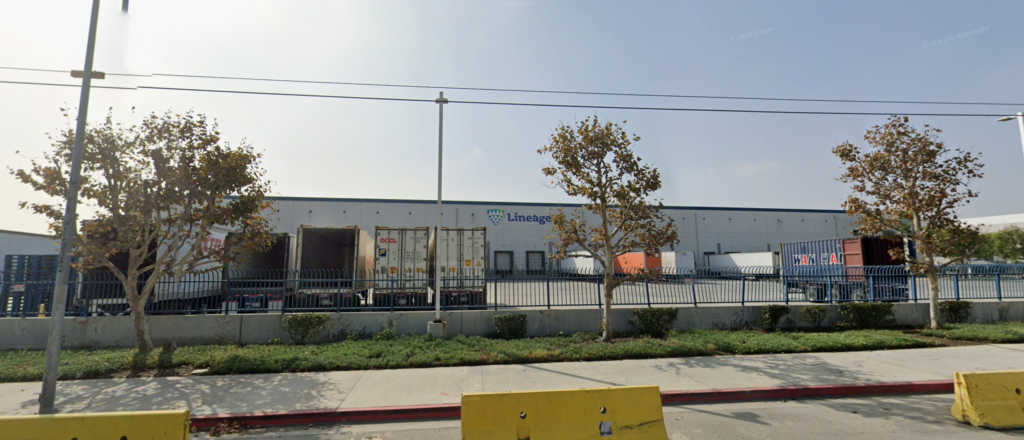
The blaze erupted shortly before 2:30 p.m. on June 17 at the 500,000-square-foot Lineage Big Bear facility at 1400 South Los Palos Street — a port-focused cold storage operation described by LAFD Capt. Jacob Raabe as a massive “ice chest.” Its steel exterior walls are packed with dense foam insulation. Its refrigeration system runs on ammonia. Inside, seven-level-high racks held roughly 85 million pounds of frozen food — meat, bread, and other grocery staples destined for Greater Los Angeles communities. Those conditions turned what might have been a manageable roof fire into one of the most operationally complex firefights LAFD has faced in recent memory.
Within hours of ignition, an ammonia leak inside the building triggered shelter-in-place orders for nearby residents and businesses. Small explosions within the structure reinvigorated the flames before crews could gain the upper hand. Ground hose lines couldn’t reach sections of the fire, and four water-dropping helicopters were brought in. The dense foam insulation and refrigerated interior allowed the fire to smolder deep inside the structure for days, flaring whenever crews believed they were approaching containment. “You’re going to see this fire ebb and flow through different conditions of smoke,” LAFD officials warned at a Friday evening press conference. “The smoke will go away and it’ll look like we have the fire out, and then 10 minutes later it could flare up again.”
Over the weekend, a Chinook helicopter performed water drops on the building’s center as a corner of the roof reignited and burned out of control. Structural hazards kept personnel out of the core cold storage zones for much of the week. LAFD integrated private sector resources directly into its incident command structure — an approach Chief Jaime Moore called unusual but effective. “This has not been a conventional firefighting operation from the onset,” Moore said Monday. “The conditions here have required us to think differently; our incident commanders have risen to the challenge.” Progress accelerated after crews tore down an exterior wall, allowing high-volume water streams to reach the fire’s interior. Firefighters also deliberately worked to collapse roof sections to punch access points from above.
By Wednesday morning, Raabe reported that all fire on the roof had been extinguished and crews were focused on interior hot spots. Water-dropping helicopters made approximately 10 drops of 500 gallons each through a hole in the roof. Infrared drones remained deployed throughout the day to identify hidden heat sources beneath the debris. The knockdown was declared at 5:58 p.m. LAFD stressed the designation does not mean the building will stop smoldering, but that active flames are no longer at risk of spreading.
The cause of the fire has not been officially determined, and the corporate finger-pointing began before the smoke cleared. Lineage, which operates as the building’s tenant, pointed squarely at Altus Power — a Connecticut-based solar energy company whose subsidiary, Los Palos Street Operating, LLC, owns the rooftop array. Notably, that array does not power the building itself; it feeds electricity into the city’s power grid. “We believe the fire started on the roof when the owner of the solar array, Altus Power, was doing tests,” Lineage said in a statement. “The solar array does not power the building directly but provides power into the city power grid. As we step up for the community, we are also urging Altus to join us in getting the Boyle Heights community the support they desperately need.”
The contractor physically on the roof that day was Pearce, a subsidiary of commercial real estate giant CBRE, which said it is cooperating with investigators. Altus Power rejected Lineage’s account entirely. “The cause of the fire where our rooftop solar array is located at the Los Palos Street facility has yet to be determined,” Altus said in a statement, adding that it is cooperating fully with authorities. LAFD has not publicly assigned blame to any party.
The ownership structure of the property ensures the liability question will be complicated. The building is owned by Chill Build Los Angeles I, LLC. Lineage operates as the tenant. The solar array is owned by an Altus Power subsidiary. The contractor performing work at the time of ignition is a subsidiary of CBRE. Four distinct entities, each with potential exposure, and no official determination yet on where responsibility begins.
Air quality became the dominant public health concern for the week. Smoke drifted miles beyond Boyle Heights and reached downtown Los Angeles. The EPA and South Coast Air Quality Management District maintained throughout the incident that monitoring had not detected anything beyond combustion byproducts typical of structural fires, with no toxic chemical readings above health-based thresholds. Ammonia briefly raised alarm during the early hours, but Lineage said it proactively pumped out remaining refrigerant and transported it offsite, and both LAFD and AQMD confirmed no measurable ammonia concentrations were recorded in the surrounding community.

Despite those assurances, residents near the warehouse were not satisfied. “I don’t think it’s over at all,” said Phoebe Horta, who lives near the facility. “Even if it’s light smoke, it’s still smoke. Hopefully it doesn’t catch up to us in the long run.” A South Coast AQMD Particle Pollution Advisory remained in effect through much of the response. City officials distributed thousands of air purifiers and masks to impacted residents, though some reported difficulty obtaining them. Two emergency shelters opened — at Pecan Recreation Center at 145 S. Pecan St. and City Terrace Park at 1126 N. Hazard Ave. Lineage brought in food trucks to provide approximately 1,000 meals to residents and firefighters and pledged to continue distributing supplies as long as needed.
UCLA experts warned that smoke from the Boyle Heights warehouse fire was highly toxic due to burning electronics and solar panels, with onshore winds trapping the plume over East LA, Pasadena, and the San Gabriel Valley. (@UCLA / X)
The Los Angeles County Board of Supervisors ratified a local emergency proclamation to expand community support, environmental monitoring, and business recovery assistance. Supervisor Hilda Solis, who initially declared the emergency, said the move was necessary to address both the immediate health impacts and the longer-term economic damage to the neighborhood. Environmental crews began arriving before the knockdown to manage hundreds of thousands of gallons of fire-water runoff, working to collect debris at the source before it could reach storm drains.
Now that the fire is out, the property owner faces the task of removing everything left inside — roughly 85 million pounds of food, much of it burned or spoiled. LAFD will partner with private contractors on removal. The Los Angeles City Controller reported LAFD-related firefighting costs totaling approximately $3 million billed to city taxpayers. Moore had set Friday as the target date for formally returning control of the building to Lineage. Firefighters will remain on site through the cleanup.
This is not the first Lineage facility to burn in a prolonged firefight. In April 2024, a different Lineage cold storage warehouse in Finley, Washington burned for more than a month before crews could bring it down.

Units Are Surrounded
The new book from Ray Dietrich. Five shootings in five months in Riverside County. The full book is coming - read how it starts, free.
